
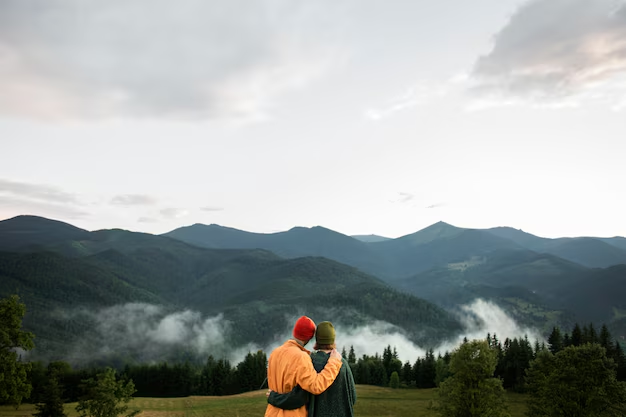
Tourism in small communities is increasingly ceasing to be entertainment for visitors and becoming a tool for developing the local economy.
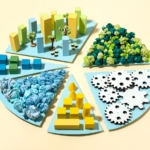
Skole is one of the regions where this model is being implemented in practice: here, tourism, craftsmanship, farming, and manufacturing form a common system—an economy of mutual reinforcement.
Tourism as an entry point into the economy
Every tourist who comes to the Carpathians spends money not only on accommodation. They buy local products, visit farms, participate in events, and leave money in the small economy.
In this case, tourism is not the ultimate goal, but a mechanism for launching domestic entrepreneurship.
In the Skole community, this approach is already evident through local initiatives: family farms, craft workshops, and food producers.
Each of them creates not just a service, but a part of the regional tourism chain.
Small businesses as drivers of regional development
The strongest growth in communities is observed where small businesses work together with local authorities.
Entrepreneurs not only create jobs, but also become agents of change — developing services, infrastructure, and communications.
In Skolivshchyna, such initiatives became the basis for the creation of the Skolivshchyna Entrepreneurs Association — a platform that brings together business, community, and institutions.
Its goal is to help local entrepreneurs attract funding, find partners, and promote their products.
An economy of partnerships, not competition
Regional development is impossible without cooperation.
Farmers, craftsmen, food producers, and estate owners are joining forces to jointly develop offerings for tourists.
This allows for the creation of comprehensive tourist routes: from excursions to tastings, from production to the sale of finished products.
Such partnerships reduce costs, improve the quality of services, and build the sustainability of the community’s economy.
Institutional support as the basis for sustainability
Without structural support, even the best initiatives remain local.
Therefore, it is important to create institutions that can unite individual projects into a system.
The Skolivshchyna Development Office acts as a coordinator of such processes:
- it helps businesses develop grant applications;
- it initiates partnership programs with communities;
- it creates conditions for joint investment projects.
Tourism as a long-term strategy, not a seasonal product
The development of tourism is not a one-off event, but a gradual process of shaping the environment.
Today, the community is investing in the basics: infrastructure, information systems, and the promotion of local brands.
Tomorrow, this will translate into stable jobs, new services, and capital inflows.
This approach allows us to view tourism not as a seasonal activity, but as part of a comprehensive strategy for the economic development of the Skole region.
Skovytsia demonstrates that modern tourism is not a separate industry, but a platform for small business development.
When the community creates conditions and entrepreneurs unite around a common goal, a new type of economy is formed — one that is open, sustainable, and focused on long-term effects.