
Recently, Natalka Cmoch, Canada’s Ambassador Extraordinary and Plenipotentiary to Ukraine, gave an interview to The Ukrainer.
It was not about politics, activities, or plans for the future. The interview was about personal matters—childhood memories, family, and Ukrainian roots. About her grandmother Natalka, whom the ambassador is said to resemble greatly in strength of character and intelligence. It also touched on the heroic struggle of Ukrainians for freedom, which for Nataliya Cmots is not just something she read about in textbooks, but the glorious life of her grandfather, Kostya Cmots, a Plast scout, hero, and district leader of the OUN in Stryi, and her grandmother, Maria Bilas, a Plast scout and OUN activist.
The Ambassador demonstrates her deep support for Ukraine. Her work as Canadian Ambassador to Ukraine is not just a diplomatic mission, but a continuation of her family’s legacy, where the struggle for a free Ukraine is now being fought on the international political arena.
In an interview entitled “The Land Calls: The Family Tree of Nataliya Tsmots,” Nataliya Tsmots says that she owes her position to the upbringing of her parents, who were active in promoting Ukraine in Canada. They gave her books to read about the Ukrainian Insurgent Army and the Organization of Ukrainian Nationalists. And, of course, they told her a lot about the history of the Tsmot family, which is an integral part of the Ukrainian national liberation struggle of the mid-20th century.
Nataliya Tsmots’ life symbolically intersects with the history of her family. On the one hand, she is a representative of successful Western democracy, and on the other, she is the heir to Ukrainian fighters who paid the highest price for the independence they dreamed of.
Grandfather Kost Tsmots
Leader of the OUN, master of conspiracy, and legend of Skolivshchyna
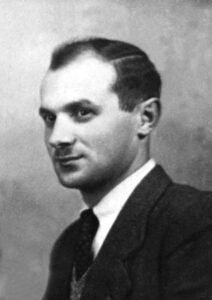 Natalka’s grandfather, Kost Tsmots, is a prominent figure in the history of the Ukrainian liberation movement. He was a prominent Ukrainian military leader and member of the Organization of Ukrainian Nationalists (OUN), who headed the OUN district leadership in Stryi in 1939–1941. His life, filled with underground struggle against two occupation regimes, was cut short at the age of 30.
Youth, Plast, and the respect of his fellow villagers
Kost Tsmot was born on February 10, 1914, in the village of Verkhne Syniovydne, which belonged to the Skole district. Therefore, Skole is the historical homeland of Natalka’s family.
He grew up in a large family of farmers who were involved in trade. Like his brothers Volodymyr (a future priest who was sentenced to 25 years in concentration camps by the occupiers) and Dmytro (who died in the OUN underground), he grew up in Plast and was a member of the 57th Ivan Mazepa Troop in Verkhne Syniovydne.
He studied at the Stryi Gymnasium. Thanks to his modesty, respect for his elders, and personal authority, he was highly respected among the local youth. The older hosts responded to Kostyantyn’s greeting with a bow: “Glory forever!” And then, in hushed voices, they added: “May he grow up healthy, he will be something.”
Brilliant operations to free underground fighters
Kost Tsmotz went down in history as a master of daring conspiratorial actions aimed at rescuing key figures of the Ukrainian underground. These operations became legendary and are described in many memoirs, including those of his fellow villager and comrade Mark Nitska.
Twice, Tsmotz successfully organized the liberation of prominent military figures from German prisons, using the same scenario both times!
September 1943. Under Kostya’s leadership, a group of OUN members dressed in German uniforms (who were fluent in German and had skillfully forged documents) arrived at the Lviv prison. They showed the administration an order for the “urgent transfer of prisoners to Berlin” for interrogation at the Gestapo headquarters and successfully freed Dmytro Hrytsai (Chornomorets) and Yaroslav Starukh (Styag) from captivity. Both later became key figures in the UPA.
In April 1943, he similarly rescued Oleksa Hasyna (Lytzar, Chervona Kalyna), the future general and chief of the UPA General Staff, from the Drohobych prison.
The fight against the NKVD: The elusive “Grad”
Tsmotz (“Grad”) also distinguished himself with unprecedented courage and success in battles against the Soviet occupiers. The Chekists openly feared him, as evidenced by their questions to agents: “Is it true that Kost Tsmotz is so strong that he can throw the first ‘horse’ he sees over a raft?”
Marko Nitska recalled Kostya’s unique elusiveness, here are a few examples:
Escape in Lviv (March 1940): During his arrest at a secret apartment, he quickly snatched a weapon from an armed NKVD officer, struck him, and fled. When asked by his comrades, the Chekist with a broken nose could only reply: “The bandit got away.”
Ambush in Zamartyniv (April 1940): Surrounded by Chekists in Lviv, Kost organized a barricade at the door, pretended to escape through the window, and when the occupiers approached him, he destroyed the entire group with accurate shots. The underground fighters escaped.
Grenade against the NKVD chief (December 1940): In the forest, he accidentally met the chief of the Bolekhiv NKVD. Hiding under fire, he waited until the Chekist began to reload his magazine and threw grenades at him, seriously wounding him.
The peasants in Tysov and Tanyava recounted: “God knows who that man was, who waged such a war in the forest and seriously wounded the NKVD chief, and then disappeared without a trace.”
Death and legacy
Tsmotz died heroically in battle on December 22, 1944, in a forest near the villages of Yushkivtsi and Devyatnyky in the Zhydachiv district. His small group of nine underground fighters, who were on their way to meet with Roman Shukhevych, ran into an ambush by an NKVD detachment of about 300 Chekists.
Before his death, Kostya Tsmots managed to get his wife Maria and son Modest out of the country, thus saving part of his family.
Kostyantyn’s son, Modest Tsmots, born in 1942 (and in whose honor his father took the pseudonym “Modest”), continued the family tradition in Plast. He became a high-ranking official in Canada. His daughter, Natalka Tsmots, is currently the Ambassador Extraordinary and Plenipotentiary of Canada to Ukraine, continuing the family history in her homeland.
(Based on materials by Yuriy Yuzich, historian, Chairman of the Regional Plast Council “Plast – NSOU”)
________________________________________________________________________
Grandmother Maria Tsmots (Bilas)
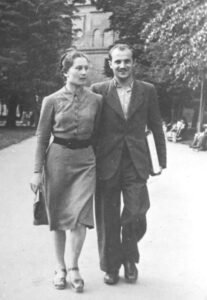 Maria Bilas studied at the Stryi Gymnasium, where she met Kost Tsmots.
Like her husband, Maria Bilas was an active member of the OUN. She worked in the OUN women’s network in the Stryi region.
Maria Bilas was not only the wife of an active OUN member, but also the sister of Vasyl Bilas, a member of the OUN and one of the most famous “terrorist martyrs” executed by the Polish authorities in 1932 for participating in the assassination attempt on Ambassador Tadeusz Goluwka and the expropriation of the post office in the town of Gorodok (Lviv region).
Natalka Tsmots is also the grandniece of another legend of the OUN resistance, Vasyl Bilas, whose name is immortalized in the prayer of Ukrainian nationalists.
_____________________________________________________________________
From Canada to Skolivshchyna
In November 2023, Natalka Tsmots visited the homeland of her illustrious grandfather in Skolivshchyna.
It was not an official visit, but a deeply personal journey to the roots of her own family.
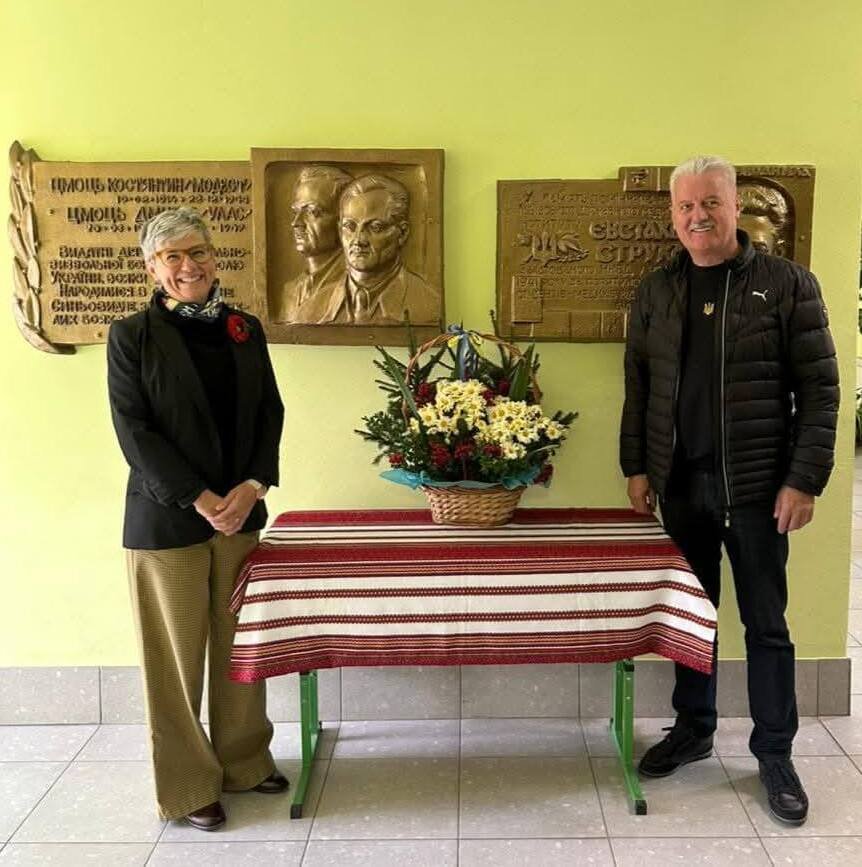
The Ambassador visited Verkhne Synevydne, the native village of Kostya Tsmots. The meeting with relatives at the local school, where her famous grandfather once studied, was particularly emotional.
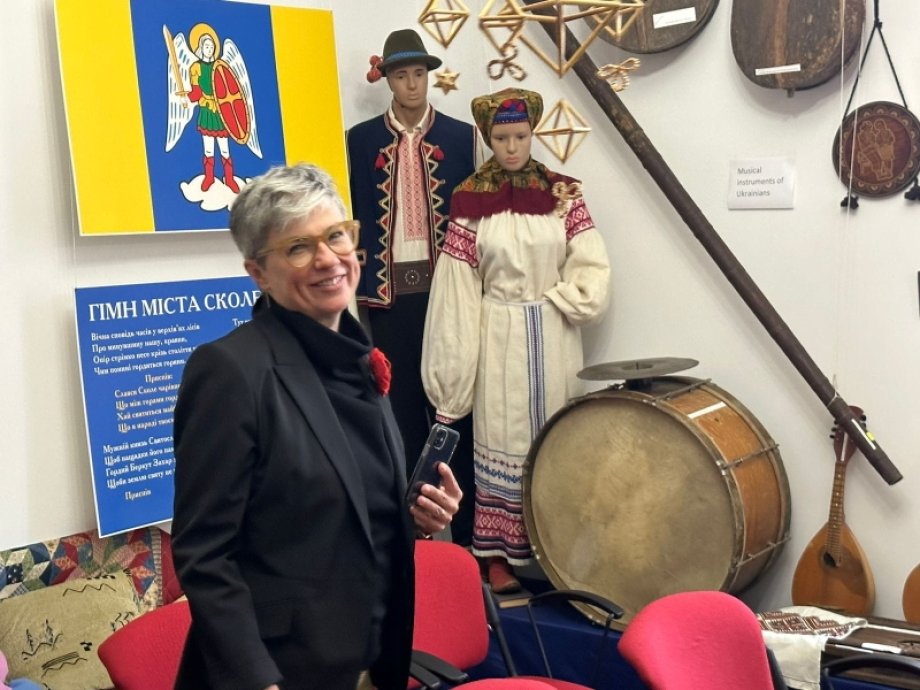
Natalka Tsmots also visited the Skolivshchyna History and Local Lore Museum (in Skole), where she discovered many details about her grandfather’s glorious heroic journey and the history of Skole and Skolivshchyna.
And not only about the past. In Skole, the Ambassador, together with Mayor Mykola Romanyshyn, honored the memory of the defenders of Ukraine who died today in the Russian-Ukrainian war, demonstrating the unbreakable unity of generations of Ukrainian heroes in the struggle for independence.
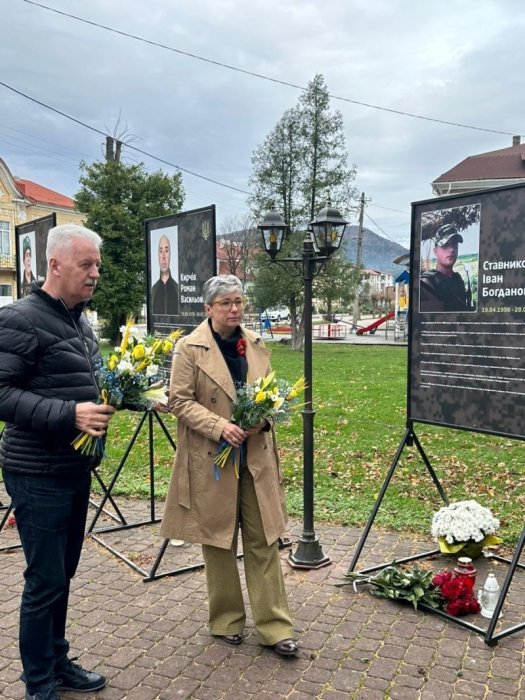
The Ambassador admitted that she was pleasantly surprised and deeply moved by the opportunity to hear so many interesting things about her grandfather’s life and struggle for Ukraine’s freedom during World War II.
She set herself the goal of returning to Skolivshchyna with her family to “delve deeper into the roots” of her family, experience its ethnicity, and pass on the spirit of her heroic ancestors to her descendants.
______________________________________________________________________________
Acknowledgements
We would like to express our deep gratitude to Igor Chudiyovich for his invaluable assistance in writing the article “Journey to the Origins. Canadian Ambassador to Ukraine Nataliya Tsmots. Genealogy, OUN, and Skolivshchyna,” as well as for kindly providing materials.
Igor Chudiyovych is a well-known local historian of Skolivshchyna, a true encyclopedist and collector who has made a significant contribution to the study and preservation of the historical heritage of his native land. For his many years of work, he has been included in the Dictionary of Personalities of Boikivshchyna – “Boikivske Suzirya.”
Igor Chudiyovich’s tireless work is a living example of the preservation of national heritage. His research includes over 200 articles in Ukrainian periodicals and a number of in-depth publications, including “On the History of Hunting and Fishing in Skolivshchyna,” “Stories of Father Mykhailo Revakovych about Hunting in Skolivshchyna,” “Ivan Martsinkiv-Senior of Ukrainian Beekeepers,” and “Narrow-Gauge Railways of the Skoliv Beskids.” And also, in 2025, a historical study entitled “Jews in the UPA.”Mr. Igor is an active public figure and initiator of the restoration of historical memory. Thanks to his efforts, in collaboration with the historical and local history society “Pysana Krynytsia,” the graves of Prince Sviatoslav and the founder of Ukrainian periodicals in Galicia, Fedir Zarevych, have been restored, and a memorial plaque to Ukrainian writer Andrii Chaikovsky has been installed in the city of Skole. He took an active part in the development of the emblem and coat of arms for the 600th anniversary of Skole and was a member of the organizing committee for the restoration of the monument to the OUN-UPA insurgents and the Way of the Cross on Mount Altana.